

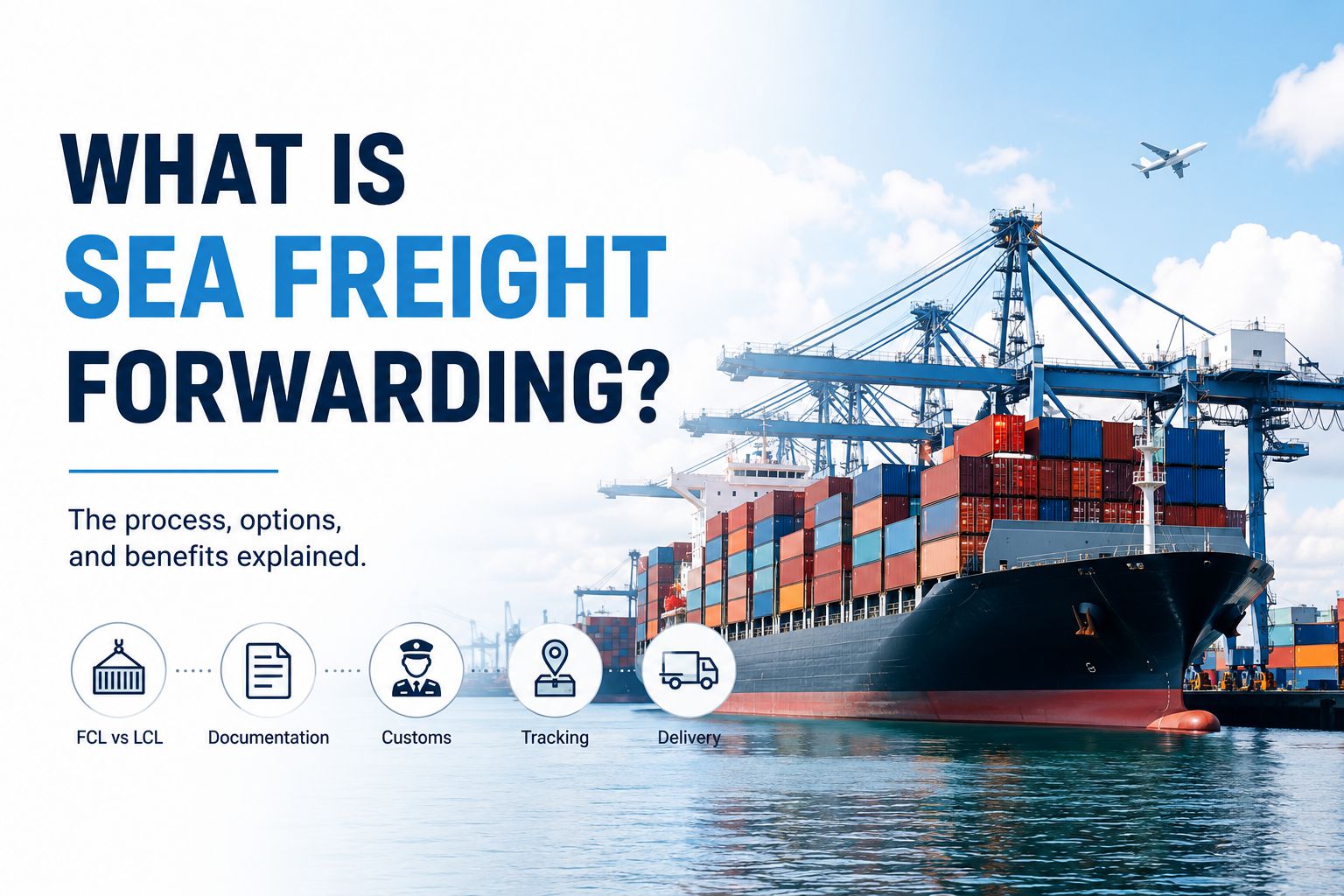
In short: What is sea freight forwarding? It's the professional coordination of moving cargo by ocean from one country to another — covering everything from carrier booking and container loading to documentation, customs, and final delivery. A sea freight forwarder acts as the single point of contact that turns a complex, multi-party shipping process into a smooth, predictable one.
This guide breaks down exactly what sea freight forwarding is, how it works step by step, and answers the most commonly searched questions businesses have before shipping cargo by sea.
Sea freight forwarding is a logistics service that manages the international shipment of goods by ocean on behalf of a business. Rather than a company negotiating directly with shipping lines, ports, and customs authorities, a freight forwarder handles all of it — acting as the link between the shipper, the carrier, and the destination.
A sea freight forwarding service typically covers:
Because ocean shipping involves multiple parties — carriers, port authorities, customs officials, and inland transport providers — a forwarder's job is to make sure all these moving parts work together without delays or costly mistakes.
Sea freight forwarding follows a structured process. While exact steps can vary slightly between providers, most reliable sea freight forwarding services follow this general flow:
The forwarder first reviews your cargo type, volume, weight, and destination, along with your required timelines. This determines whether your shipment is better suited to a Full Container Load (FCL) or Less than Container Load (LCL) arrangement, and which trade route makes the most sense.
Using established relationships with shipping lines, the forwarder books space on a vessel with a sailing schedule and rate that fits your needs. Strong carrier networks often mean better pricing and more flexible routing options.
Your cargo is loaded into the appropriate container. If you don't have enough volume for a full container, it may be consolidated with other shipments (LCL), allowing you to still benefit from ocean freight cost savings.
This is one of the most critical — and most often underestimated — stages. Bills of lading, commercial invoices, packing lists, certificates of origin, and customs declarations all need to be accurate and submitted on time. A forwarder manages this so shipments aren't held up at port.
Before cargo can move across borders, it must clear customs at both the origin and destination. Forwarders coordinate with customs brokers to ensure duties, taxes, and regulatory requirements are handled correctly.
Once the vessel departs, the forwarder monitors the shipment's progress, providing visibility on vessel location, estimated arrival times, and any potential delays — such as port congestion or transshipment issues.
Depending on the agreed terms, cargo is delivered either port-to-port (where the receiver arranges onward transport) or door-to-door (where the forwarder manages inland delivery all the way to the final destination).
This is essentially how Fletching Logistics' sea freight forwarding service operates — combining global carrier partnerships with end-to-end coordination so businesses don't have to manage each stage independently.
Handling international ocean shipping without a forwarder is possible in theory, but in practice it introduces significant risk and inefficiency. Here's why most businesses choose to work with a sea freight forwarding service instead:
This is one of the most frequently asked questions when businesses are deciding how to ship internationally.
FactorSea FreightAir FreightCostLower cost per unit, ideal for bulk/heavy cargoHigher cost, better for small/urgent shipmentsSpeed2–6 weeks depending on route1–5 days typicallyBest forNon-urgent, high-volume shipmentsTime-sensitive, lighter shipmentsEnvironmental impactLower carbon footprint per tonneHigher carbon footprint
If your shipment isn't time-critical and involves large or heavy cargo, sea freight is almost always the more economical choice.
1. What is sea freight forwarding? Sea freight forwarding is the professional management of shipping goods internationally by sea, covering carrier booking, container selection, documentation, customs coordination, and tracking — so businesses can move cargo without managing the process themselves.
2. How long does sea freight shipping take? Transit time depends on the route, destination port, and carrier schedule. It typically ranges from 2 to 6 weeks, factoring in port congestion, transshipment points, and customs clearance timelines.
3. What's the difference between FCL and LCL shipping? FCL (Full Container Load) means your cargo occupies an entire container, offering faster handling and more security. LCL (Less than Container Load) means your shipment shares container space with other cargo, which is more cost-effective for smaller volumes.
4. Is sea freight cheaper than air freight? Yes. Sea freight offers the lowest cost per unit, particularly for heavy or high-volume cargo, making it the preferred option whenever shipments aren't time-sensitive.
5. How is sea freight pricing calculated? Pricing depends on cargo volume (CBM), weight, container type, destination port, carrier choice, fuel surcharges, and seasonal demand. Getting a quote early typically secures better rates.
6. Is my cargo safe during ocean shipping? Yes. Sea freight forwarding follows international maritime regulations and container safety standards, with optional marine insurance available for added protection.
7. Can I track my sea freight shipment? Yes, most sea freight forwarding services — including Fletching Logistics — provide real-time tracking, giving visibility into vessel location, milestones, and estimated arrival.
8. How do I choose the right sea freight forwarding service? Look for a provider with strong carrier relationships, transparent pricing, customs and compliance expertise, flexible container options, and responsive customer support.
Sea freight forwarding exists to remove the complexity from international ocean shipping. From booking and containerisation to documentation, customs, and final delivery, a forwarder ensures cargo moves efficiently, safely, and cost-effectively — without businesses having to manage dozens of moving parts on their own.
If you're planning an international shipment and want a team that handles the entire process end-to-end, Fletching Logistics offers a dedicated sea freight forwarding service built around reliability, transparency, and global carrier connectivity.
Have a shipment to plan or questions about your specific cargo needs? Get in touch with our team for a tailored sea freight quote.