

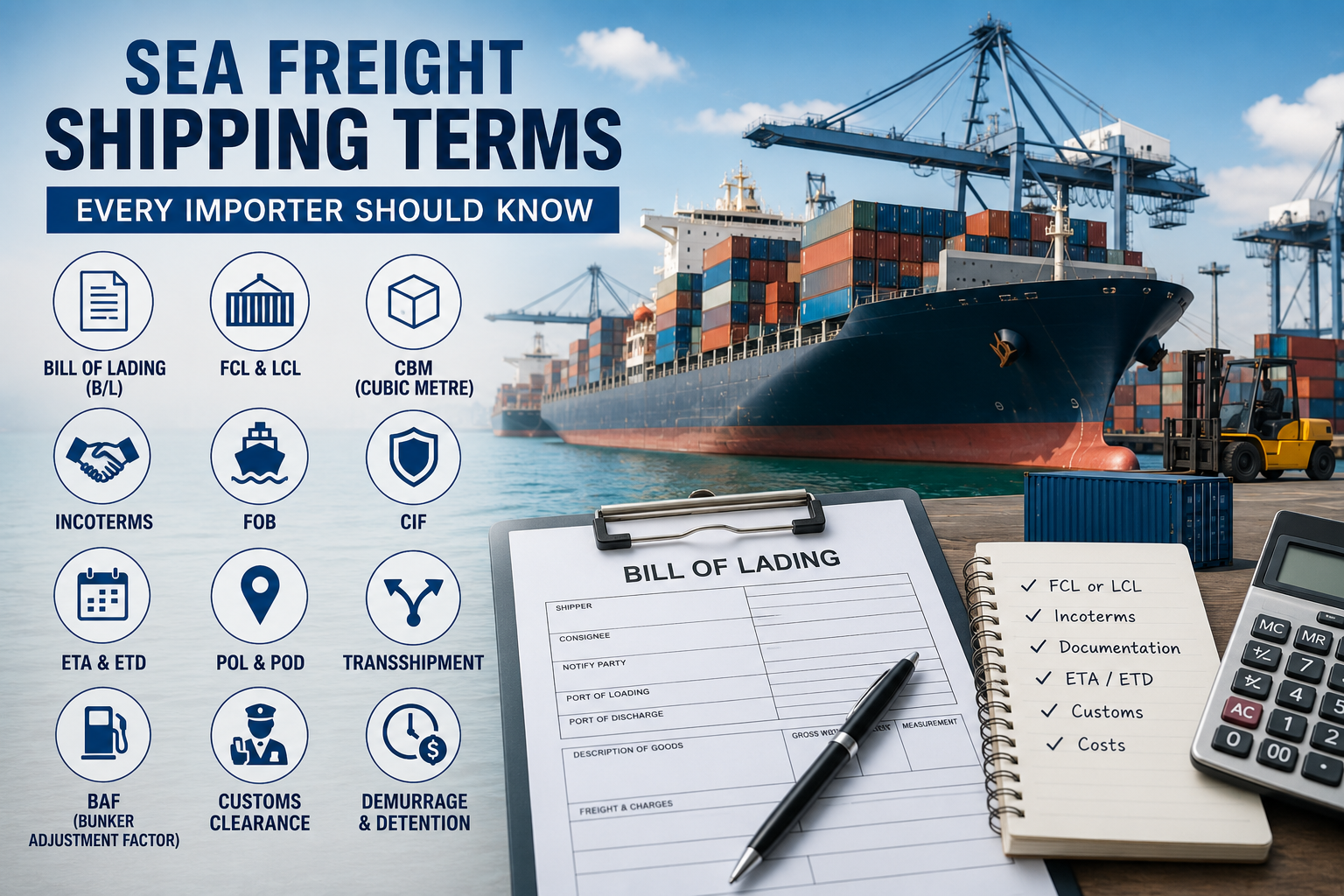
If you're new to importing goodsinternationally, the paperwork, conversations with freight forwarders, andcarrier documentation you encounter will be filled with industry-specificlanguage that isn't always self-explanatory. Understanding the most important seafreight shipping terms upfront saves time, prevents costlymisunderstandings, and gives you far more confidence when managing shipmentsand reviewing quotes.
This guide covers the most essential seafreight shipping terms every importer should know, explains what each one meansin plain language, and answers the questions importers most frequently searchwhen navigating international ocean freight for the first time.
Freight forwarding involves multipleparties — shipping lines, customs authorities, port operators, and inlandtransport providers — each using standardised industry terminology. Whenimporters don't understand these terms, they risk misreading quotes, agreeingto unfavourable shipping terms, or failing to comply with documentationrequirements that hold up clearance.
Learning the core vocabulary doesn'trequire becoming a logistics expert — but it does mean you can engage with yourfreight forwarder on equal footing, understand exactly what you're being quotedfor, and catch issues before they become expensive problems.
The Bill of Lading is the most criticaldocument in sea freight — serving as a contract between shipper and carrier, acargo receipt, and a document of title. Without it, cargo cannot typically bereleased at the destination port.
FCL (Full Container Load) means yourcargo occupies an entire container exclusively, priced per container. LCL (Lessthan Container Load) means your cargo shares space with other shipments, pricedper CBM or weight — the more cost-effective option for smaller volumes.
CBM is the standard unit for measuringcargo volume in sea freight, particularly for LCL shipments. It's calculated bymultiplying the length, width, and height of the cargo in metres.
Incoterms are standardised trade termsdefining who is responsible for costs, risks, and logistics at each stage of ashipment. The most common in sea freight are FOB (Free on Board), CIF (Cost,Insurance, and Freight), EXW (Ex Works), and DDP (Delivered Duty Paid) — andagreeing on the correct one is critical before any purchase is finalised.
Under FOB, the seller's responsibilityends once cargo is loaded onto the vessel at the origin port. From that point,the buyer assumes freight costs, insurance, and risk — making it one of themost commonly used Incoterms in import shipments.
Under CIF, the seller pays freight andmarine insurance to the destination port, but risk transfers to the buyer atthe point of loading. This means the buyer is responsible for claims eventhough the seller arranged the insurance.
ETA (Estimated Time of Arrival) is theprojected arrival date at the destination port. ETD (Estimated Time ofDeparture) is the scheduled departure date from the origin port. Both areestimates that can shift due to port congestion, weather, or mechanical issues.
The POL is the origin port where cargo isloaded; the POD is the destination port where it is unloaded. Both appear onthe Bill of Lading and are core to every sea freight booking.
Transshipment means cargo transfers fromone vessel to another at an intermediate port before reaching the finaldestination — adding transit time and additional handling compared to a directsailing.
BAF is a fuel surcharge added to the basefreight rate to reflect current vessel fuel costs. It fluctuates with fuelprices and is typically listed separately in freight quotes.
Customs clearance is the process ofsubmitting required documentation to destination customs authorities so cargocan be legally released from the port — covering declaration of goods, duties,taxes, and import compliance.
Demurrage applies when a container isn'tcollected within the carrier's free period after arrival at the destinationport. Detention applies when a container is held outside the port beyond theallowed time. Both accumulate as daily charges and can become significantwithout prompt clearance and collection.
When you receive a freight quote,cross-reference the terms used here. Understanding what each line item means —BAF, POL/POD, FCL vs LCL — helps you compare quotes accurately rather than justlooking at the total figure.
Before agreeing on trading terms with yoursupplier, confirm which Incoterm applies and understand what it means for yourcost and risk responsibilities — particularly when cargo transfers from theseller's responsibility to yours.
When the B/L is issued, verify itaccurately reflects your cargo details, ports, and agreed shipping terms.Errors on the B/L can cause significant delays at the destination.
Track your shipment's ETD and ETAactively and plan customs clearance timelines around the most current arrivalestimates, not the original schedule.
Submitting customs paperwork before thevessel arrives avoids delays and reduces the risk of demurrage chargesaccumulating while documentation is processed.
A reliable forwarder should clearlyexplain any term or charge in your documentation. Asking upfront is alwaysbetter than discovering a misunderstanding after cargo has already departed.
Understanding these terms is part of whatmakes working with an experienced partner like Fletching Logistics' sea freight forwarding serviceso valuable — the team guides importers through every stage of the process withclear communication, rather than leaving documentation and terminology as asource of uncertainty.
1. What are the most important seafreight shipping terms every importer should know? Themost essential terms include Bill of Lading, FCL, LCL, CBM, Incoterms(especially FOB and CIF), ETA, ETD, Port of Loading, Port of Discharge, BAF,customs clearance, and demurrage — all of which appear regularly in freightdocumentation and quotes.
2. What is the difference between FOBand CIF in sea freight? Under FOB, the buyer assumesrisk and cost from the point the cargo is loaded at the origin port. Under CIF,the seller arranges and pays for freight and insurance to the destination port,though risk still transfers to the buyer at the point of loading.
3. What happens if I don't understandthe Incoterm in my purchase agreement?Misunderstanding your Incoterm can mean unexpected costs or unclearresponsibility when cargo is damaged or delayed in transit. It's one of themost important terms to confirm and understand before finalising a purchase.
4. What is demurrage and how do Iavoid it? Demurrage is a daily charge that applieswhen a container isn't collected or returned to the carrier within the allowedfree period after arrival. Avoiding it requires proactive customs clearance andprompt container collection after the vessel arrives.
5. What does transshipment mean and doesit affect my shipment? Transshipment means your cargochanges vessels at an intermediate port before reaching its destination. Ittypically adds a few days to transit time and introduces additional handling,though it's often unavoidable on certain trade routes.
6. Who is responsible for customsclearance — the importer or the freight forwarder?Ultimately the importer is responsible for meeting customs requirements at thedestination, though freight forwarders typically coordinate this processclosely with customs brokers on the importer's behalf.
7. What is a BAF charge and why doesit appear on my freight quote? BAF (Bunker AdjustmentFactor) is a fuel surcharge added to the base freight rate to reflect currentvessel fuel costs. It fluctuates with fuel prices and is stated separately inmost freight quotes.
8. How do I know if my Bill of Ladingis correct? Check that the B/L accurately reflectsyour cargo description, quantity, weight, Port of Loading, Port of Discharge,consignee details, and agreed Incoterm. Any discrepancies should be correctedbefore the vessel departs, as amendments after departure are significantly morecomplex.
Knowing the key sea freight shippingterms doesn't make you a freight forwarder — but it does make you a farmore informed importer. From understanding what your quote includes to knowingyour rights and responsibilities under your agreed Incoterm, this vocabularyforms the foundation of every successful international import shipment.
Fletching Logistics works with importers atevery level of experience, providing clear guidance and end-to-end coordinationso that documentation, terminology, and customs requirements never become abarrier to getting cargo where it needs to go.
Have a shipment to plan or questionsabout any of the terms above? Get intouch with our team for straightforward, expert guidance.