

.png)
Choosing the right shipping method is one of the most important logistical decisions a business can make. Get it right and you'll enjoy reliable delivery timelines, controlled costs, and satisfied customers. Get it wrong and you risk delays, inflated expenses, and damaged supplier relationships. Two of the most widely used methods for moving commercial goods are road cargo transport and sea freight - and each has distinct strengths depending on your cargo type, destination, budget, and timeline.
This guide breaks down both options in detail, helping you make a confident, informed decision for your business shipping needs in 2025 and beyond.
Road cargo transport refers to the movement of goods by truck or heavy goods vehicle (HGV) over road networks. It is the backbone of domestic and regional freight across Europe and other connected landmasses, and plays a critical role in first-mile and last-mile delivery for international shipments.
Fletching Logistics provides professional road freight forwarding services designed to deliver flexibility, speed, and reliability across a wide range of cargo types and routes.
Key characteristics of road cargo transport:
Sea freight involves transporting goods in shipping containers aboard cargo vessels across oceans and major waterways. It is the dominant mode of transport for intercontinental trade, handling the vast majority of the world's goods by volume each year.
Key characteristics of sea freight:
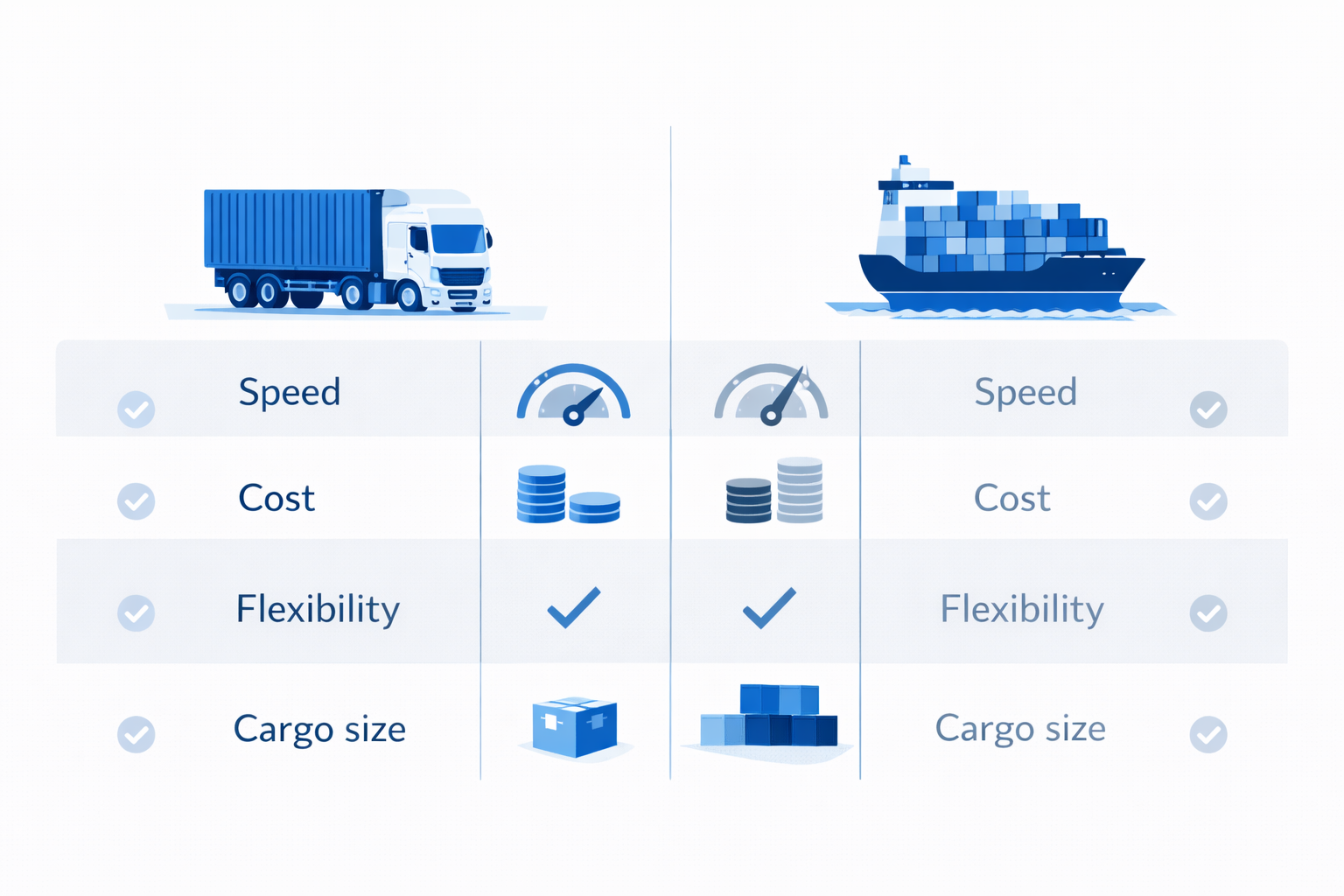
Road cargo transport is significantly faster for short to medium distances. Within Europe, for example, cross-border road shipments can be completed in 1-5 days. For regional deliveries, road freight offers unmatched speed and scheduling flexibility.
Sea freight, by contrast, involves longer transit times - typically 10-40 days depending on the origin, destination, and routing. While this is perfectly acceptable for non-urgent cargo planned well in advance, it is not suitable for time-sensitive shipments.
Winner for speed: Road cargo transport
For large volumes travelling long intercontinental distances, sea freight is considerably more cost-effective. The ability to consolidate enormous quantities of goods into a single container makes the per-unit shipping cost very low.
Road freight costs are generally higher per kilometre for long distances, but for shorter routes and smaller loads, road transport often works out more economical when you factor in port fees, terminal handling charges, and documentation costs associated with sea freight.
Winner for cost (long distance, high volume): Sea freight Winner for cost (short to medium distance): Road cargo transport
Road cargo transport offers unmatched flexibility. Trucks can pick up directly from your warehouse and deliver to the final destination without any intermediate handling - a genuine door-to-door service. Routes can be adjusted, and scheduling is far more adaptable compared to fixed vessel departure windows.
Sea freight requires access to port facilities at both origin and destination, meaning road transport is almost always needed as a complement for the first and last legs of the journey. This adds time, cost, and additional handling touchpoints.
Winner for flexibility: Road cargo transport
Sea freight excels when it comes to large, heavy, or bulky cargo. A standard 20-foot shipping container holds approximately 25–28 tonnes of cargo. Oversized machinery, bulk commodities, and industrial equipment that cannot be moved by road are natural candidates for sea freight.
Road freight vehicles have legal weight and dimension limits that vary by country, making sea freight the only viable option for certain types of extremely large or heavy cargo.
Winner for large/heavy cargo: Sea freight
Sea freight produces significantly lower carbon emissions per tonne per kilometre than road or air freight, making it the more sustainable choice for long-distance international shipping. For businesses with environmental targets and sustainability commitments, this is an increasingly important consideration.
Road freight, while less carbon-efficient per kilometre, is essential for the first and last mile of almost every supply chain - and modern carriers are increasingly investing in low-emission and electric vehicle fleets.
Winner for sustainability: Sea freight (for long-haul)
Road cargo transport typically offers superior real-time tracking, with GPS-enabled vehicles providing precise location data throughout the journey. Updates are frequent and predictable.
Sea freight tracking has improved significantly in recent years, but vessel movements are subject to weather, port congestion, and schedule changes that can affect visibility. Updates are less granular during the ocean leg compared to road transport.
Winner for tracking: Road cargo transport
Fewer handling points generally mean lower risk of damage. Road freight, with its direct delivery model, reduces the number of times cargo is loaded, unloaded, and transferred - which is particularly important for fragile or high-value goods.
Sea freight involves more handling stages - loading at the origin warehouse, transport to port, terminal handling, vessel loading, unloading at destination port, and final delivery. Each stage carries a small risk of damage or loss.
Winner for cargo safety: Road cargo transport (for fragile goods)
Step 1 - Identify Your Destination
If you're shipping within the same continent or across connected road networks, road cargo transport is likely the most practical option. For intercontinental routes separated by ocean, sea freight is the standard choice.
Step 2 - Assess Your Timeline
How urgently does your cargo need to arrive? If you have a tight deadline measured in days, road freight is the answer. If your supply chain allows for several weeks of lead time, sea freight becomes viable and cost-effective.
Step 3 - Calculate Your Volume and Weight
For large, heavy shipments where you can fill a container, sea freight offers significant cost savings. For smaller loads or part shipments, road transport (LTL) or LCL sea freight can both work - compare the all-in costs carefully.
Step 4 - Evaluate Your Cargo Type
Fragile, high-value, or perishable goods often travel better by road due to fewer handling touchpoints and faster transit. Bulk commodities, heavy machinery, and non-urgent manufactured goods are well-suited to sea freight.
Step 5 - Consider Your Budget
Request quotes for both options and compare the total landed cost - including customs, terminal fees, insurance, and delivery charges - not just the headline freight rate.
Step 6 - Think About Customs and Documentation
Sea freight typically involves more complex customs procedures. If your team lacks experience with import/export documentation, working with a freight forwarder like Fletching Logistics simplifies both road and sea shipments significantly.
Step 7 - Choose the Right Logistics Partner
Select a freight partner experienced in both modes so they can advise objectively based on your specific needs rather than pushing a single solution. Fletching Logistics offers both road and sea freight solutions, giving clients genuinely unbiased guidance.
Road freight is the right choice when:
Sea freight is the right choice when:
For short to medium distances within a continent, road freight is often more cost-effective when you factor in all the additional costs of sea freight such as port charges, terminal handling, and inland delivery. For long intercontinental routes with large volumes, sea freight wins on cost.
Road freight within Europe typically takes 1-7 days. Sea freight between continents generally takes 15-40 days depending on the route. For Asia to Europe, for example, expect 25-35 days by sea.
Modern sea freight tracking has improved greatly, but road freight still offers more granular, real-time GPS tracking throughout the journey. Sea freight tracking updates at port milestones rather than continuously.
LCL (Less than Container Load) is a sea freight option where your cargo shares a container with other shippers' goods - you pay only for your portion. LTL (Less than Truckload) is the road freight equivalent - your goods share a truck with other shipments, reducing cost for smaller loads.
Both are generally safe when managed by professional logistics providers. Road freight carries slightly lower handling risk due to fewer transfer points. Sea freight exposes cargo to weather and longer periods in transit, making robust packaging and cargo insurance essential.
Yes. Road freight regularly crosses international borders within connected regions such as Europe. It involves customs clearance at border points, which a professional freight forwarder manages on your behalf.
Q: Can I combine road and sea freight for a single shipment?
Absolutely. Most international shipments use a combination - road transport for collection and delivery (first and last mile), and sea freight for the main intercontinental leg. This is called multimodal shipping and is coordinated seamlessly by a freight forwarder.
Q: What cargo cannot travel by sea?
Certain perishable goods, time-critical items, and some dangerous goods have restrictions on sea transport. Your freight forwarder can advise on suitability based on your specific commodity.
Q: Does sea freight require special packaging?
Yes. Cargo travelling by sea is exposed to humidity, temperature variations, and significant movement during the ocean crossing. Proper packaging, palletisation, and moisture protection are strongly recommended.
Q: Which method is better for eCommerce businesses?
It depends on your supply chain model. Many eCommerce businesses use sea freight for bulk restocking shipments from manufacturers and road freight for domestic distribution. A hybrid model managed by a logistics partner is often the most efficient approach.
Q: How do I get an accurate quote for road or sea freight?
Provide your freight partner with the origin and destination, cargo dimensions and weight, commodity type, required delivery date, and preferred incoterms. Fletching Logistics can provide detailed quotes for both road and sea freight options.
Q: Is cargo insurance mandatory for sea freight?
It is not legally mandatory but is strongly recommended. The value of most commercial cargo far exceeds the limited liability that carriers offer under standard terms. Comprehensive cargo insurance provides proper protection for your goods.
At Fletching Logistics, we believe the best logistics advice starts with understanding your business - not promoting a single mode of transport. Our team has extensive experience in both road cargo transport and sea freight solutions, giving you objective, tailored guidance on the most efficient and cost-effective way to move your goods.
From road freight across European trade lanes to full container load sea freight on intercontinental routes, we manage every detail - documentation, customs, carrier coordination, and delivery - so you don't have to.
Whether road cargo transport or sea freight is right for your next shipment, the Fletching Logistics team is ready to help you make the smartest, most cost-effective choice.
Contact Fletching Logistics today to speak with a freight specialist and receive a tailored quote for your shipment. Let's move your business forward - by road, by sea, or both.
This article is intended for general informational purposes. Shipping costs, transit times, and service availability vary based on route, cargo type, carrier, and market conditions at the time of booking.