

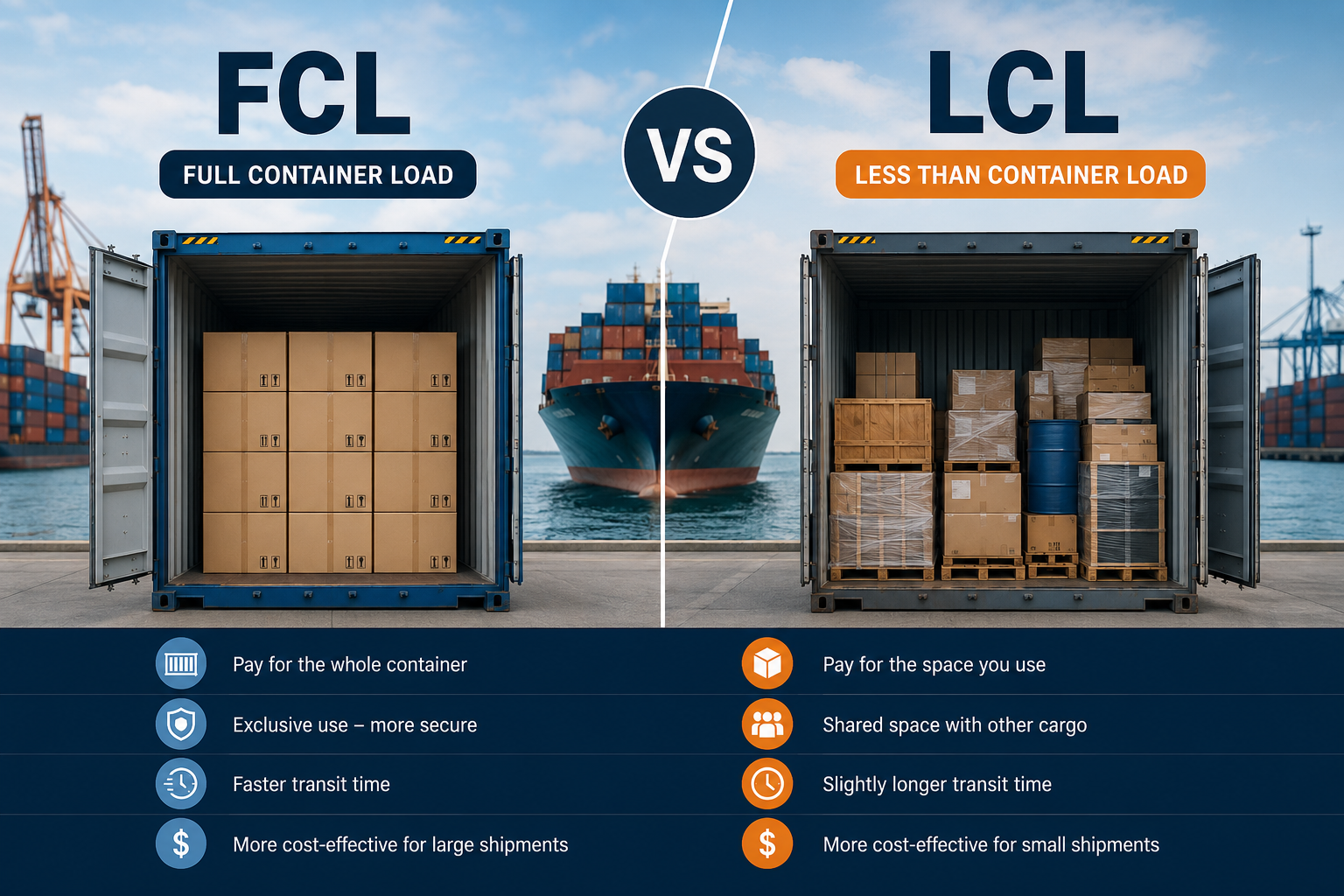
One of the most practical decisions ininternational sea freight is choosing between Full Container Load and Less thanContainer Load shipping. Get it right and you save money without compromisingdelivery timelines. Get it wrong and you either pay for space you don't use orend up with higher per-unit costs than necessary.
Understanding FCL vs LCL shippingisn't complicated — but the right choice depends on specific factors that varyby shipment, and making the decision without understanding those factors oftenleads to unnecessary cost.
This guide compares FCL and LCL shippingside by side, explains exactly how to determine which option suits your cargo,and answers the questions businesses most frequently search before choosingbetween them.
FCL (Full Container Load) shipping meansyour cargo occupies an entire container — typically a 20-foot or 40-footstandard container — exclusively. The container is loaded, sealed, and shippedwith only your goods inside, from origin port to destination port.
FCL is priced per container regardless ofhow full it actually is, which means the cost per unit decreases the more cargoyou load into the container. It also means faster port handling since there'sno consolidation or deconsolidation process involved.
LCL (Less than Container Load) shippingmeans your cargo shares container space with shipments from other businesses.Rather than paying for the entire container, you pay only for the volume (cubicmetres) or weight your cargo occupies.
This makes LCL more cost-effective forsmaller shipments that don't need or can't justify a full container, while theconsolidation process does add some additional handling time compared to FCL.
Calculate the total cubic metres (CBM) ofyour shipment. This is the starting point for any FCL vs LCL comparison, sincevolume is the primary factor in determining which option is morecost-effective.
A standard 20-foot container holdsapproximately 25–28 CBM of cargo, while a 40-foot container holds around 55–60CBM. Knowing these figures gives you a benchmark to compare against your cargovolume.
As a general guide, LCL tends to be morecost-effective for shipments below around 15 CBM, while FCL becomes morecompetitive as volume approaches and exceeds that threshold. However, thisisn't a fixed rule — actual rates vary by trade lane, carrier, and seasonaldemand.
Rather than assuming which is cheaper,request quotes for both FCL and LCL based on your specific cargo dimensions,weight, origin, and destination. The difference in practice can be smaller orlarger than expected depending on current market rates.
If your cargo is time-sensitive, FCLtypically moves faster due to fewer handling touchpoints. LCL adds time forconsolidation at the origin and deconsolidation at the destination — usually afew extra days, but worth accounting for if your deadline is tight.
Fragile or high-value cargo benefits fromthe reduced handling and exclusive space of FCL. With LCL, your cargo ishandled alongside other shipments during consolidation and deconsolidation,which introduces slightly more opportunity for damage.
If you ship regularly in smaller volumes,you have the option to either consolidate multiple shipments into a single LCLbooking or wait and combine orders to justify FCL. A freight forwarder can helpyou assess which approach works best across your shipping pattern over time.
For businesses unsure which option suitstheir specific cargo and route, Fletching Logistics' sea freight forwarding serviceprovides guidance based on actual shipment data rather than generic estimates,helping you choose the option that genuinely saves more money for yoursituation.
FCL becomes the more cost-effectiveoption when:
● Your cargo volume approaches orexceeds 15–20 CBM
● You're shipping regularly enoughto consistently fill or nearly fill a container
● Your cargo is fragile, high-value,or sensitive to additional handling
● Speed is a priority and you wantto avoid the extra transit time LCL adds
● You want complete control overcontainer contents without sharing space
At sufficient volume, the per-unit costof FCL drops well below what LCL would charge for the same cargo, making FCLthe clearly cheaper option for larger, regular shipments.
LCL becomes the more cost-effectiveoption when:
● Your cargo volume is below 15 CBMand doesn't justify paying for a full container
● You need to ship smaller orirregular volumes without waiting to accumulate enough for FCL
● Your shipment isn't time-critical andthe few extra transit days from consolidation are acceptable
● You're a smaller business orstartup that needs the flexibility of paying only for space used
● You're testing a new trade lane orsupplier relationship before committing to larger shipment volumes
For small and medium-sized businessesespecially, LCL provides access to ocean freight cost savings without therequirement of filling an entire container.
1. What is the main difference betweenFCL and LCL shipping? FCL means your cargo fills anentire container exclusively, while LCL means your cargo shares container spacewith other shipments and you pay only for the volume or weight your cargooccupies.
2. Which is cheaper — FCL or LCL shipping? It depends on your cargo volume. LCL is generally cheaper for smallershipments below around 15 CBM, while FCL becomes more cost-effective as volumeincreases and the per-unit container cost decreases.
3. How is LCL shipping priced? LCL is priced per cubic metre (CBM) or per tonne of cargo weight,whichever is greater — meaning both dimensions and weight matter whencalculating your LCL cost.
4. Is FCL faster than LCL shipping? Generally, yes. FCL avoids the consolidation and deconsolidationprocess that LCL requires, which adds a few extra days to the overall transittime.
5. Is LCL shipping safe for fragilegoods? LCL involves more handling than FCL since cargois consolidated with other shipments, which can increase the risk of minordamage for fragile items. FCL's exclusive container use makes it a safer optionfor fragile or high-value cargo.
6. What size shipment is the breakevenpoint between FCL and LCL? As a general guide, 15–20CBM is often cited as the approximate breakeven volume, though actual ratesvary by route, carrier, and season — getting quotes for both options is themost accurate way to compare.
7. Can I switch between FCL and LCLacross different shipments? Yes. Many businesses use amix of both, choosing LCL for smaller or irregular volumes and switching to FCLwhen cargo accumulates to a level that makes a full container morecost-effective.
8. Does a freight forwarder helpchoose between FCL and LCL? Yes. A freight forwarderassesses your cargo volume, route, timeline, and budget to recommend the mostcost-effective option — and can provide quotes for both so you can comparedirectly.
The FCL vs LCL shipping decisioncomes down to volume, timeline, cargo type, and current market rates. LCLoffers the flexibility and cost savings smaller shipments need, while FCLdelivers lower per-unit costs and faster, more secure transit for larger cargovolumes. The right choice isn't always obvious without comparing actual quoteson your specific shipment.
Fletching Logistics helps businesses evaluateboth options clearly, combining real-time carrier rates with route expertise toensure every shipment moves by the method that genuinely saves the most money.
Not sure whether FCL or LCL is the rightfit for your next shipment? Get intouch with our team for a direct comparison and tailored quote.